Friday, July 6, 2012

Monocots vs. Eudicots - Tyler

Typically flowering plants & regular foliage are divided into two groups- Monocots and Eudicots (or Dicots.)
They're distinguished by the following:

Eudicots have a rather  complex system of auxiliary veins which are expressed between the major ones- more of a network.

Monocots however, have a not-so-much- network of veins running parallel to the stem... they're all in one direction and tend to not cross. You can KIND of see the veins it in the photo... but grasses are usually monocots. 

The next easily distinguished characteristic between the two would be the number of petals the flowers reproduce; Monocots produce three petals on each flower (or multiples of three.)

In contrast to Monocots, Eudicots produce petals consisting of multiples of 4 or 5. This is used a lot, but not always reliable... there are some strange plants that don't follow the rules.

Finally, you can tell wether a plant is a Monocot or Eudicot by their roots. In Eudicots, the roots grow from the lower part of the embryo, near the radicle. Monocot roots are usually adventurous and grow wherever they want.

The plants can also be determined by a few more characteristics, based on the number of coltyledons, the pollen structure and the vascular bundles.
:)

Saturday, June 30, 2012

P.S.

Got this email from Joel Prock... check it out!

I saw this on tv earlier and I thought it was really cool! There was also a part of the episode that talked about forcing CO2 into the ground to extract oil but I couldn't find that part on the internet. Hope you're having a great summer!

-Joel

http://www.history.com/shows/modern-marvels/videos/green-algae

IMportant STuff...

Ok - so I LOVE your posts about The Hot Zone.  I too love it and agree that some of it can be confusing in the back and forth.. I found myself making notes in the margins and dog earring pages so I could go back and re-read or reference.  It's hard to remind yourself that this is non-fiction!! I agree that Nancy Jaxx is pretty impressive.  I don't know if I could do what she does.  Had it been fiction, Tyler, I think you are right that she would have been infected.  But not everyone comes out of this unscathed.   And Ansley, I am glad you are so candid with your response to the book.  It is pretty gross and yes, scary.  I hope that over the course of the year, you will find that being armed with information can make things a little less scary. Of course, that doesn't change the reality!  One of the ideas I get out of this is how, the more we know the less we know.  It's what I find so fascinating about biology and why I love it so much.

Now for some business: 1- I have only heard back from Tyler confirming that he understands about the text.  I want to hear from all of you.
2- Let's now get in the habit of commenting on each other's posts.  That's one of the main points of this blog - a way for us to have "class" discussions online.
3- Hope you are enjoying not only your summer, but also this assignment :)
4- P.S. after this past weel with College Board's APBio Summer Institute I am SO EXCITED to share with you!!!

Friday, June 29, 2012

HotZone1- Tyler

I found this book surprisingly...interesting. I misjudged it initially, but it's actually quite gripping- I have to say the Jaxx storyline is my favorite so far. The beginning in particular confused me, I like things to be in order and this book was all over the place, jumping from year to year back to the previous year and then ten years later... but I really like it! I knew a small bit about Ebola walking into this, but I didn't know it was divided into three types or anything... In my previous biology class we'd watched contagion and then discusses other viruses, so I knew about their travelling methods and cycles, and how they can be manipulated by animals, which is what I'm suspecting...

The most interesting part of the story for me was when Mrs. Jaxx was working in the Biohazard lab, with the caged animals. I thought for sure that she'd be infected- that's the latter stories typically follow. But I had to keep reminding myself as I was reading that this was real and exists. That makes it all the more interesting!

I did read ahead, I had a 16 hour car ride to kill... but not enough to figure it out yet! And it's driving me slightly crazy because typically I like to figure things out quickly and analytically. It's turned into one of my new favorites. :)

~Tyler

The Hot Zone Part 1

Well to be completely honest I love this book, but the beginning was a little harder to read. I believe it was due to the different time periods and who all was infected and such. I want to know who will find the cure first. Also the levels of the viruses were fascinating to me becuase I would have read it as one being the most dangerous instead of level four. Nancy Jaxx is my favorite character because it would take dedication to work at her high risk job; while having the job of a mother and wife. I don't remember if I read this or not but I was wondering if there was a guy in the boook that was infected with the Ebola virus and survived or was I imagining it? But anyways I love this book so far and can't wait to read more becuase it is very suspenseful.
This book has completely grossed me out. I honestly never imagined that a virus could mutilate a body in such a way that Ebola does. I get sick to my stomach when I read it. It is very interesting though. I can not wait to find out what is causing Ebola. The different dates have started to confuse me along with the similar names of places, people, and the viruses. If I was ever infected with something as destructive as Ebola I would be terrified. The scariest thing to me is the fact that they know so little about it and have virtually no way to cure it. As I read I have become more interested and can not wait to find out who will find the cause and maybe a cure for Ebola.

The Canadian Boreal Forest Food Chain.


(Organisms on different levels of the same food chain... kinda.) It required a few more pictures to tie it all together.

Alright, I'm going to attempt to explain one of Canada's food chain, because I discovered I have enough pictures for it. Some of them are a bit blurry because I took them from far away... I didn't really want to get that close to the animals... and most of then are located at my cottage in Parry Sound, Ontario, Canada, or the Yukon and Northwest Territories. These animals span all across Canada, it's the same food chain pretty much everywhere regarding large wild animals.

You should know that this food chain doesn't really have levels, it's more of a BIG mindmap. Animals are known to kill other animals all over the food chain, near the bottom, near the top,  but do not necessarily eat them for nutrients. They're just protective or have violent natures. The food chain also has animals that may have the same predators, but the 2 predators also hunt eachother regularly, to the food chain can change. There isn't really a dominant predator, or top of the food chain, so to speak.

So this is the Boreal Forest, specific to Canada and parts of Russia. Unlike the Deciduous forest, it does not usually contain pine trees. It houses all of the animals (although some travel in and out) that you're about to see, and provides a food source for specifically the rabbit and the moose.
The rabbits also feed off of the humans crops and things planted in the forest, and other green fertile things they can eat.. they're just kind of there as a source for the foxes.

This next animal, the fox, preys primarily on small animals such as rabbits and rodents that live in the forest.


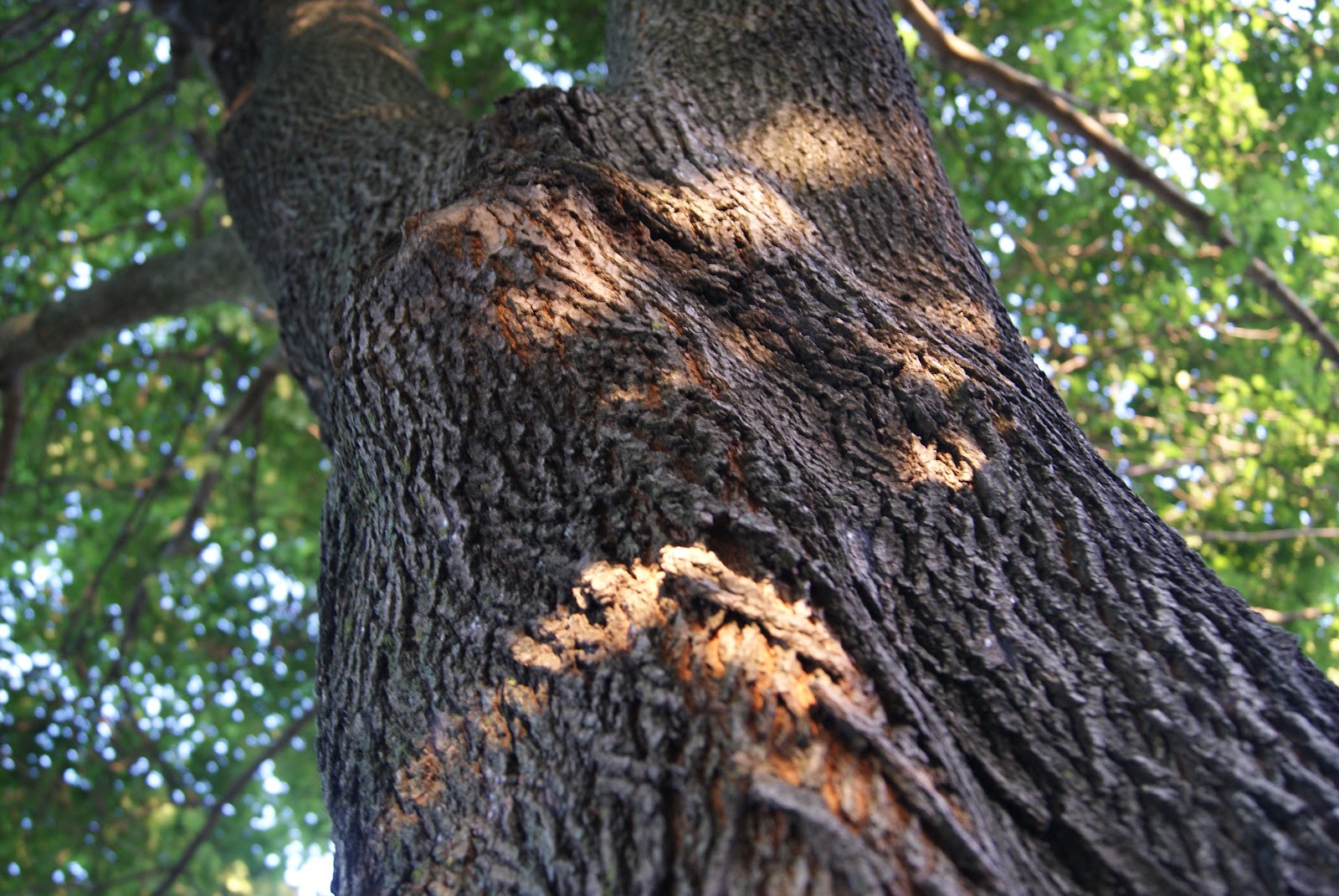
Then comes the moose... Moose live in the boreal forest and gain nutrients by eating literally anything green within it. Moose also eat roots and strip the bark off trees (which is why I've included the picture of tree bark above.) They keep to themselves, which is why I kind of isolated this one, (it doesn't eat rabbits or foxes) but provide food to bears and wolves, yet more than usually kills them. They're strong forces against wolves, and the predators will not attack unless a single moose is by itself and there is a very large number of wolves ready in the pack.


The next two animals are constantly battling for dominance in the food chain and will eat anything above for their main diet (except the plants) ; The multiple types of wolves and the different types of bears.


The Grey Wolf (top far left) was taken at a hunting display in the Yukon. They will eat anything they can bring down in large groups, even bears, which is why the top of the chain is unclear. The arctic wolf travels through both the tundra and the boreal forest, and also preys on smaller animals individually (although it's rare that they're by themselves) and larger animals in packs.


Finally, there's the bears. the black bear at the dump at my cottage and the brown bear on display in the Yukon are protective of their offspring and will attack anything they deem threatening. Between wolves and bears, bears are probably more dominant in the food chain. Polar bears often venture into the northernly territories (if anyone knows anything about Canadian geography) but do not live in the forest. It's not natural.

So... that's the food chain! It was kind-of hard to isolate a single part of it, so I wound up covering most of it. And I know, Mrs. P, that you're only counting 5 pictures for points, but otherwise I wouldn't have been able to really put it together :)