I have to admit, I didn't think part 2 would be as interesting as it was... I thought Part 1 would be the introduction, and part two would kind of be that boring bridge between the intro and the climax. It was a bridge, but it did a really good job. The Jaxx storyline also keeps it in perspective- again I have to remind myself that this is a true story.
I knew the minute Geisbert sniffed that test tube/bottle that the situation would NOT turn out well... and much later in the book: when the majority of the people trapped within this story have such a thin layer of protection between themselves and the viruses, (and the viruses in context to the rest of the world). At that point I really understood how the whole ordeal could have happened easily, it gave quite the ominous effect.
What I'm kind of predicting is... well, the impression of a fourth sister was given between the viruses when that test occurred involving Ebola Zaire, when it glowed? Since the virus has crossed the ocean to North America now, I'm betting that this will be the virus that causes mass havoc. That's my prediction...?
-Tyler
Friday, July 13, 2012

The Hot Zone Part 2
This part was a lot less confusing to me because all of the stories started to come together. The different characters started working together. The coolest part was during the experiment Jahrling conducted when he was in the storage closet. I can't imagine discovering the virus you have been dealing with is Ebola and is pretty much a death sentence. This book is definitely still gross but it is very interesting. I can't wait to figure out where the rest of the story goes!
Ansley Dieckmann- Scavenger Hunt #4
.JPG)
This mushroom is an example of an organism that has spores. Spores are simply reproductive structures. Spores can produce a new organism by mitotic division. Many Fungi, bacteria, plants, and algae all have a sporophyte stage in their life cycle.
.JPG)
My ear is an example of connective tissue because it is made of connective tissue. Connective tissue is made up of cells and protein fibers. These tissues provide support for other body tissues.
.JPG)
This butterfly and flower are an example of mutualism. Mutualism is just the way two organisms of different species interact. This relationship benefits both organisms involved.

These fish have scales which help them swim faster in the water. This is an example of an adaptation of an animal because the speed of a fish can result in its death or survival.
.JPG)
These plants perform cellular respiration.Cellular respiration occurs in all prokaryotic and eukaryotic cells. This is the most efficient way for cells to harvest energy. There are three main stages to cellular respiration: Glycolysis, the citric acid cycle, and the electron transport chain.
Well as I sit on the beach for the very last day of my vacation to St. Martin I truly must say that reading the book and get wifi was astounding. The book really goes on to tell you how much the C.D.C. and the Army didn't get along. These kind of things really make it hard to believe in anything of importance being handled properly and maturely. Instead you've got a he said she said report as Preston tries to document what everyone had to say. I just hope that when outbreaks or disasters happen nowadays it is handled way better and done more efficiently.
The book is still very interesting. The stories that kind of seemed random in the beginning are now starting to make sense. I especially liked the description about the knife used to cut the crumb. It is hard to believe things that small can literally be sliced into many equal pieces. My favorite part was how the Ebola Zaire lit up under the microscope. I don't think I would be able to sit there knowing I was inches away from the most deadly virus known to man. I understand that the virus has to be grown in order to tell what it is. But couldn't that make it an even bigger risk if something were to happen? They said that five virus particles could start a whole outbreak but the lab is growing thousands of them. I'm not really getting how the murder of Jerry Jaax fits into this story. It just seems kind or random putting the mystery of a murder into a book about disease.
Thursday, July 12, 2012
Kelly - Scavenger hunt post #4

1.
In this facility the U.S Department of
Agriculture and EPCOT's Land Pavilion research ways to grow plants and fish. The fish provide a
natural fertilizer for the plants and the plants keep the water clean for the fish.
This is an example of mutualism; a symbiotic relationship between two
different species where both benefit. Here the fish and the plant benefit, but
are not dependent on one another.
The next photos
are from the Pangani Forest Exploration Trail in Disney’s Animal Kingdom
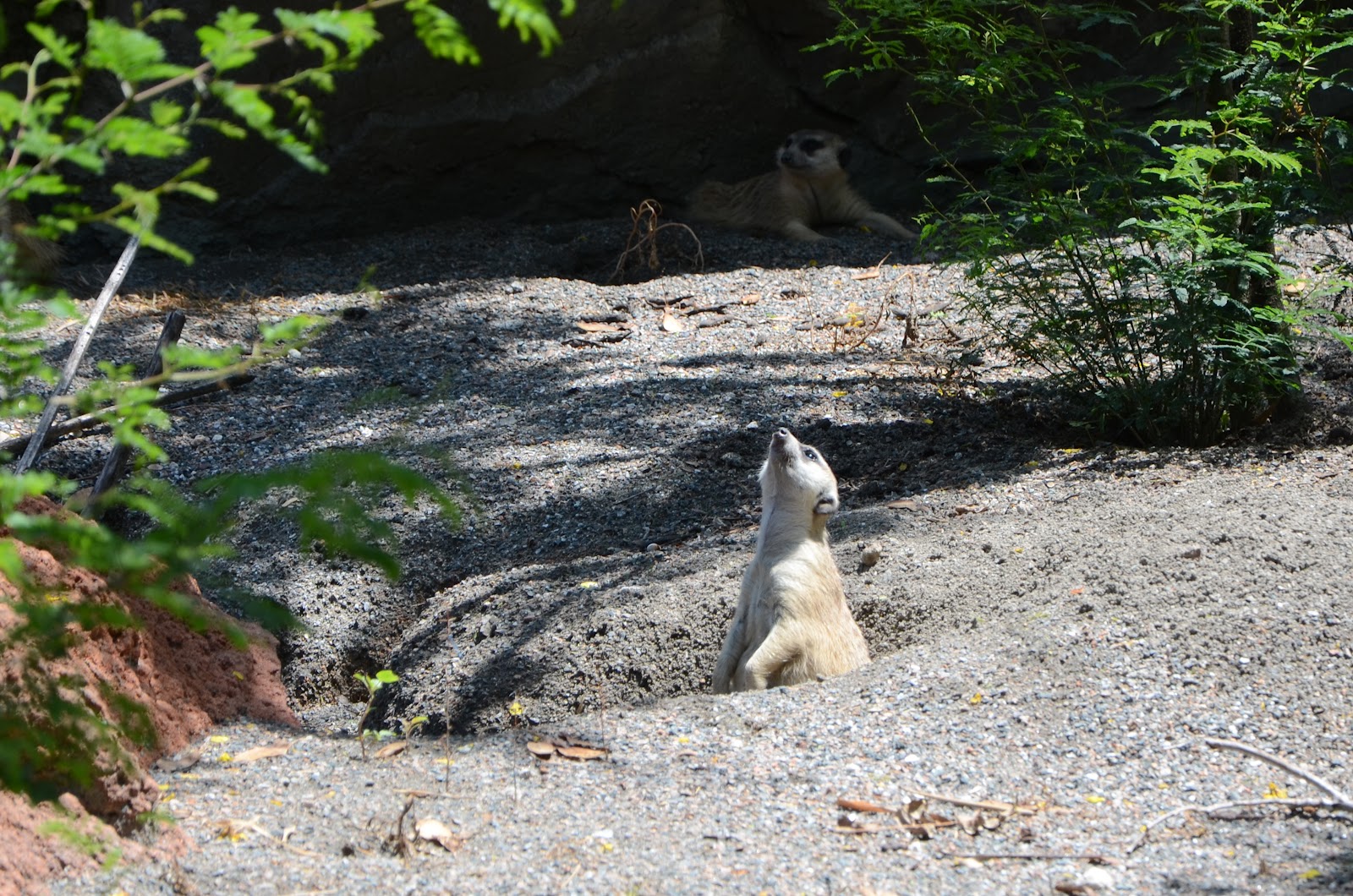
2.
This
meerkat is showing altruistic behavior; when one animal shows a behavior that
is beneficial to others, but it can put them at risk. Meerkats live in colonies
of 3 to 30. They take turns standing guard looking for predators. If one is
seen they make a barking noise to alert the others. They put themselves at risk
because they are more visible to the predators. It may also be reciprocal
altruism, where the individual makes a sacrifice for others and expects the
same in return, because the meerkats take turns standing guard.
The
next two sets of pictures show territorial behavior. Animals defend areas against
other animals of the same species where they have a nest, where they mate or
have food for themselves and their offspring.


3. The fish in the
first picture was in a cove-like area where young fish were (smaller dark ones
not the larger yellow ones). Next, another fish tries to swim into the area.
The third photo shows the intruder being chased away.


These three
photos show territorial behavior of gorillas. The first is of a gorilla that
came into an area and started to eat some bamboo. The gorilla in the second
photo was sitting about 50 ft away but got up as soon as he saw the other one sit
down and start to eat. The last photo shows the gorilla leaving the area when
the other one approached.

4. Giraffes have physical and behavioral adaptations
that help them survive. Their long neck allows them to eat leaves high on trees
that other herbivores can’t reach. This reduces competition for food. Having
long necks also allows them to see predators. Their prehensile (adapted to
grasp objects) tongue lets them strip the leaves off of branches. Behavioral
adaptations include staying in groups and near other herbivores which makes
looking for predators easier.

5.
A population is a group of animals of the same
species, living in the same habitat. These two animals are part of the
population of okapi along the Pangani
Forest Exploration Trail. Their nearest relative is the giraffe; they classified
in the family giraffidae. One theory is that giraffe’s developed longer necks
because of competition for food in the grasslands of the Savannah. The okapi live
in the rainforest in the Congo Basin and didn’t face that competition so there
was no need to develop a longer neck. Both the giraffe and okapi have
prehensile tongues. What looks like horns on both animals’ heads are actually
skin covered bone.
Scavenger Hunt #4

This dandelion is an example of a C3 Plant. A C3 plant contains 3 carbon atoms before entering into the Calvin Cycle of photosynthesis. Such as a dandelion.

Such as C3 plants, C4 plants have 4 carbon atoms before entering the Calvin Cycle of photosynthesis. Corn is an example of C4 plants.

Crassulacean acid metabolism stand for CAM and a plant utilizes this metabolism as an adaptation for dry conditions. During the night, when the carbon dioxide enters the stomata it is converted into organic acids. During the day when the stomata is closed, the carbon dioxide is released from the Calvin cycle. Plants that do not need a lot of water are classified as CAM plants, so for my example I used a cactus.

Where my thumb is located is an example of the chloroplast in a leaf. The Calvin cycle occurs in the stoma and the chloroplast of a plant. Calvin cycle is series of reactions during photosynthesis that produces glucose from carbon dioxide.

Yes this is a picture of my nose, which is an example of connective tissue. My nose connects, supports, and surrounds other tissues and organs. The cartilage of my nose supports the nasal cavity which classifies it as connective tissue.
Subscribe to:
Comments (Atom)